將傳統字意轉化為現代設計語言,提升室內設計、裝修與辦公家具尺寸判定的精準度
文公尺不只分紅黑:為什麼要重新讀懂字意?
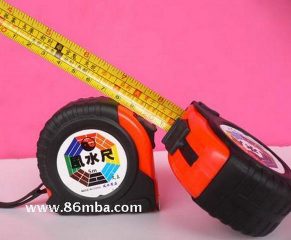
多數人在使用文公尺時,只記得一條簡單規則:紅字是吉、黑字是凶。
實際上,紅字裡的「財、義、官、本」各代表不同的意義與狀態,甚至可以視作對空間與使用行為的「期待」。
傳統上,如〈辦公室風水-魯班尺/文公尺字的涵意你可了解?〉一文中,就提到:財有錢財、寶庫、迎福;本有本位、興旺;義連結正義、添丁、貴子;官則帶著官運、順科、富貴。
如果只把它們通通視為「好字」,在空間與家具尺寸上就失去細緻對應的可能。
對室內設計與室內裝修而言,更合適的做法,是把這四個紅字視為四種不同的「空間功能語言」,依據其象徵意涵配合空間用途,讓文公尺成為尺寸規劃與選擇的輔助工具,而不是限制設計的牢籠。
以下拆組達人將依序說明:財、義、官、本四字如何由傳統字義,轉換成現代空間意涵,作為實務上真正可以操作的判斷標準。
財:流通與迎福——面向外界的窗口與舞台
文公尺中,財字下轄「財物、財德、寶庫、六合、迎福」,指的是資源進出、人事往來與福分聚集,共通點是「在流動中帶來收穫」。
財象的現代空間位置
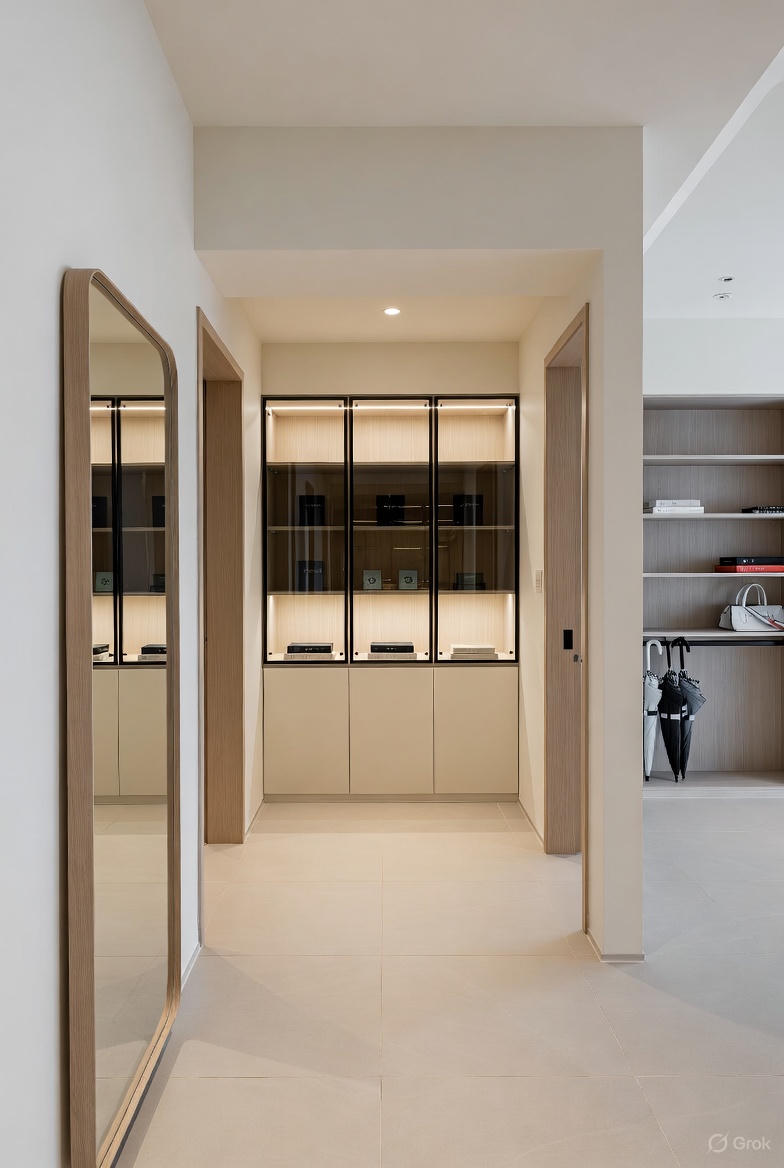
出入口附近的櫃體與檯面
櫃台與收銀區
主要動線兩側的展示面
玄關與開放式展示櫃
這些位置的共同特徵,是人流與視線容易聚集、承接來客與資訊流入、形成第一印象。
財象的尺寸應用
玄關櫃寬度
前台/櫃台檯面長度
展示櫃開口深度
若希望強調「迎接、展示、帶動流動」,便可優先讓關鍵橫向尺寸落在財象紅字區段。
義:協作與支援——多人共享與互動的場域
義字在文公尺中,下轄「正義、行善、添丁、益利、貴子、大吉」,重點在於人際連結與互相成就。
義象的現代空間位置
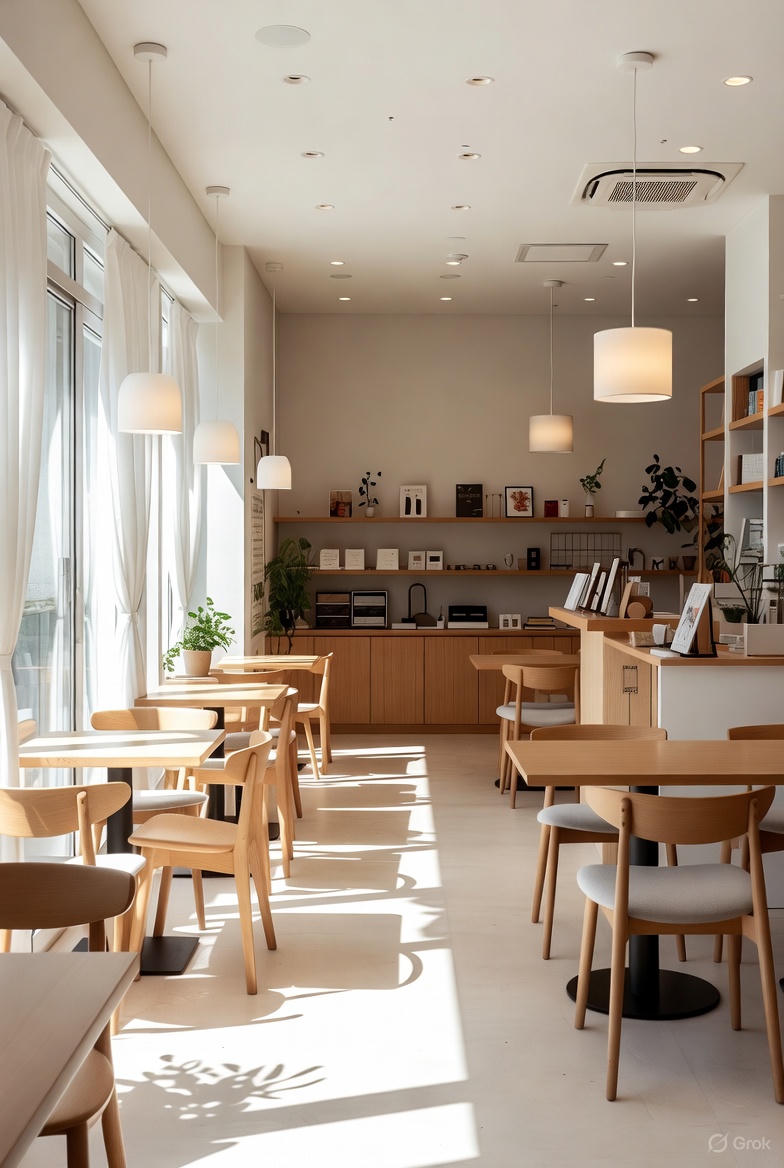
餐桌、客廳中央桌
共用長桌、協作桌
茶水與備餐檯
服務與接待區的共用櫃體
這些位置通常由多人同時或輪流使用,需要兼顧交流感與距離感。
義象的尺寸應用
桌面與檯面的寬度
共用櫃體的橫向尺寸
義象紅字能強化「一起用、一起分享」的心理感受。
官:秩序與權責——界線與主位的指標
文公尺中的官字,下轄「官運、順科、橫財、進益、富貴」,重點在於正式性、權責與主位象徵。
官象的現代空間位置
主管桌
會議桌主位
部門界線的門框
處理重要文件的家庭工作桌
這些位置擁有代表性與決策性。
官象的尺寸應用
主管桌與會議桌深度
主位前方距離
門框開口尺度
若希望呈現秩序與穩重,可優先讓這些關鍵尺寸落在官象紅字區段。
本:穩定與累積——長時間停留與長期保存
本字包含「本位、本體、財至、登科、興旺」,象徵根基、累積與持續性。
本象的現代空間位置
臥室區
書桌、工作桌
重要文件櫃
庫存層板
這些位置共通點是:使用頻率高、停留時間長、需要穩固。
本象的尺寸應用
書桌深度
衣櫃與儲物櫃有效深度
層板尺寸
本象紅字能提升「放得住、靠得住、累積得起來」的心理穩定度。
黑字仍是「避凶優先」,但不用過度綁手綁腳
文公尺中的病、退財、劫財、害等黑字,多與破財、爭訟、失去相關。
哪些位置屬於必須優先避凶的關鍵控制點?
主要出入口
主管桌桌面
唯一的大型收納(大衣櫃、金庫櫃)
若難以避免局部落黑字,可透過:
調整另一方向尺寸
調整門片開啟方式
補強同空間內其他家具的吉字象
黑字是警示,不是禁令。
實務操作建議:先問「這裡要做什麼」
文公尺的四大象可簡化為空間語言:
財=流動與迎接
義=協作與共享
官=秩序與權責
本=穩定與累積
使用前先問三個問題
這個位置是做什麼用途?
它是否是空間的關鍵控制點?
在不落黑字的前提下,應選哪個紅字象作主調?
玄關:財為主、略帶官
餐桌:義為主、兼顧本
書房:本與官之間取平衡
最細緻的操作可交由查表工具,本篇提供的是「理解行為 → 選象」的邏輯框架。
拆組達人空間規畫小教室(FAQ)
Q1:文公尺能用來決定任何家具或檯面的高度嗎?
高度不屬於文公尺的適用範圍。
高度是人體工學最敏感尺寸,差 2~3 公分就會影響肩頸。
文公尺主要適用於橫向尺寸(寬、深、門框比例)。
Q2:櫃體高度可以用象限(財/義/官/本)來判斷嗎?
不行。
櫃體高度涉及視線、伸手範圍、安全性,是空間功能核心,必須以人體工學為主。
文公尺僅能協助判斷:櫃寬、櫃深、門片比例。
Q3:哪些高度最不能用文公尺選?
書桌/工作桌高度
餐桌高度、椅面高度
廚房檯面高度
洗手台檯面高度
立面櫃(眼水平以上)
展示架層板高度
高度=人體工學領域,不可用字象取代。
延伸閱讀
- 文公尺在室內設計與室內裝修中的現代功能:尺寸與空間語意(前言篇)
- 文公尺四大吉字怎麼用?從「財義官本」讀懂空間用途與家具尺寸(定義篇)
- 文公尺四大吉象 × 三大空間應用指南|室內設計與室內裝潢的尺寸(實務篇)
- 文公尺應用篇|複合用途空間的尺寸判定方法(應用篇)
- 文公尺尺寸對照表|家具與裝潢常用尺寸快速查表(工具篇)
- 文公尺數學邏輯|42.9cm 循環 × 八段落點 × 公分公式換算(公式篇)
以下為英文翻譯版(English Version Below)
**How to Use the Four Auspicious Zones of the Wengongchi:
Reading Space Functions and Furniture Dimensions through “Wealth / Harmony / Authority / Foundation” (Definition Chapter)**
Turning traditional character meanings into a modern design language
to improve dimensional decisions in interior design, renovation, and office furniture planning
Beyond “Red vs Black”: Why We Need to Re-read the Meanings
Most people use the Wengongchi (Luban ruler) with a very simple rule in mind:
red segments are auspicious, black segments are inauspicious.
In reality, the red segments are divided into four symbolic zones:
- 財 (Cái) – Wealth
- 義 (Yì) – Harmony / Mutual Benefit
- 官 (Guān) – Authority / Status
- 本 (Běn) – Foundation / Stability
Each zone represents a different state, intention, and expectation toward how the space will be used.
Traditional explanations often describe them like this:
- Wealth (財) – wealth, treasure, receiving blessings
- Foundation (本) – core, base, prosperity, thriving
- Harmony (義) – justice, kindness, family growth, beneficial connections, noble offspring
- Authority (官) – career, formal recognition, success in examinations, material prosperity
If all of these are treated simply as “good symbols,” then the chance to precisely match spatial function and furniture dimensions is lost.
For interior design and renovation, a more useful approach is to treat these four auspicious zones as four different “spatial function languages.”
We interpret their symbolic meanings, match them to the intended use of each zone, and let the Wengongchi support dimensional decisions—instead of locking design into rigid superstition.
Below, 拆組達人 (Disassembly & Assembly Lab) explains how each of the four zones—Wealth, Harmony, Authority, Foundation—can be translated from traditional meanings into modern spatial semantics, and turned into practical, actionable decision criteria.
**Wealth (財): Flow and Welcome
— Windows and Stages Facing Outward**
On the Wengongchi, the Wealth zone usually includes terms like “wealth,” “treasure,” “harmony with others,” and “welcoming blessings.”
The common thread is resources and people flowing in and out, and the gains that arise from this movement.
Where the Wealth Zone Fits in Modern Spaces
- Cabinets and countertops near main entrances
- Reception counters and cashier desks
- Display surfaces along main circulation routes
- Entry foyers and open display shelving
These are locations where:
- People and sightlines naturally converge
- Visitors and information flow into the space
- First impressions are formed and reinforced
How to Use the Wealth Zone for Dimensions
Typical horizontal dimensions where the Wealth zone is helpful:
- Foyer cabinet width
- Reception / front-desk countertop length
- Display shelf or case opening depth
When the design intent is to emphasize welcoming, showcasing, and encouraging flow,
key horizontal dimensions in these locations can be prioritized within the Wealth (財) red segments.
(Original CTA reference: “How do we use auspicious red segments correctly in residential interiors?” is integrated here as the practical guideline above.)
**Harmony (義): Collaboration and Support
— Shared Zones for Interaction**
On the Wengongchi, the Harmony zone includes terms like “justice,” “doing good,” “family growth,” “benefit,” “noble offspring,” and “great fortune.”
The focus is on relationships, mutual support, and shared benefit.
Where the Harmony Zone Fits in Modern Spaces
- Dining tables and central coffee tables in living rooms
- Shared long tables and collaboration tables in offices
- Tea stations and pantry counters
- Shared cabinets in service or reception areas
These positions tend to:
- Be used by multiple people, either simultaneously or in rotation
- Require a balance between closeness and comfortable distance
- Encourage conversation, sharing, or informal meetings
How to Use the Harmony Zone for Dimensions
Key horizontal dimensions:
- Tabletop widths
- Countertop widths
- Horizontal dimensions of shared cabinets
The Harmony (義) zone strengthens the psychological sense of
“We use this together” / “This is a place for sharing and mutual support.”
**Authority (官): Order and Responsibility
— Indicators of Boundaries and Primary Positions**
On the Wengongchi, the Authority zone (官) is associated with “career,” “formal achievements,” “unexpected gains,” “promotion,” and “wealth.”
The emphasis is on formal roles, responsibility, and primary seats.
Where the Authority Zone Fits in Modern Spaces
- Executive or manager desks
- Head positions at conference tables
- Door frames that mark departmental boundaries
- Home workstations where important documents are handled
These locations typically have:
- Representational meaning
- Decision-making power
- Symbolic or actual authority
How to Use the Authority Zone for Dimensions
Relevant dimensions include:
- Depth of executive desks and conference tables
- Clearance distance in front of the main seat
- Door opening widths that mark important thresholds
When the goal is to express order, structure, and seriousness,
these key dimensions can preferentially align with the Authority (官) red segments.
**Foundation (本): Stability and Accumulation
— Long-Stay Zones and Long-Term Storage**
The Foundation zone (本) includes meanings such as “center,” “root,” “arrival of wealth,” “passing examinations,” and “prosperity.”
It symbolizes base, accumulation, continuity, and long-term growth.
Where the Foundation Zone Fits in Modern Spaces
- Bedrooms and sleeping zones
- Study desks and work desks
- Cabinets for important documents
- Shelving used for long-term inventory or archives
Shared characteristics:
- High usage frequency
- Long-time occupancy or frequent access
- Need for stability and reliability
How to Use the Foundation Zone for Dimensions
Typical horizontal dimensions:
- Desk depth for study or focused work
- Effective depth of wardrobes and storage cabinets
- Shelf depths and lengths for long-term storage
The Foundation (本) zone strengthens the feeling that:
“Things can be stored safely, relied upon, and steadily accumulated here.”
(Original CTA “Which red segments are correct for commercial spaces and shops?” is reflected here by focusing Foundation on long-stay and storage-heavy areas.)
Black Segments: Still “Avoid First,” but Don’t Over-Restrict Yourself
On the Wengongchi, negative zones like “illness,” “loss of wealth,” “theft,” or “harm” are typically grouped as black segments.
They symbolically relate to loss, dispute, or depletion.
Where Should Black Segments Be Avoided with Highest Priority?
Key control points where we try hardest to avoid black segments:
- Main entrance openings
- Executive desk surfaces
- The only major storage unit (e.g., main wardrobe, safe cabinet)
What If a Black Segment Cannot Be Avoided?
If certain dimensions unavoidably fall into black zones, mitigation strategies include:
- Adjusting dimensions along the other axis (e.g., depth instead of width)
- Modifying door leaf direction or opening pattern
- Compensating by using strongly auspicious red segments on other key furniture in the same space
In this framework, black segments function as warnings, not absolute prohibitions.
Practical Workflow: Always Start with “What Happens Here?”
For design purposes, the four auspicious zones can be simplified as a spatial language:
- Wealth (財) = Flow and Welcome
- Harmony (義) = Collaboration and Sharing
- Authority (官) = Order and Responsibility
- Foundation (本) = Stability and Accumulation
Before using the Wengongchi, ask three questions:
- What is the intended function of this location?
- Is it a critical control point for the entire space?
- Assuming we avoid black segments, which auspicious zone should be the primary “tone”?
Examples:
- Entrance foyer → Wealth as main tone, with a slight emphasis on Authority
- Dining table → Harmony as main tone, with support from Foundation
- Study or home office → A balance between Foundation and Authority
The most detailed numerical decisions can be handled by a dimension look-up table.
This chapter provides the conceptual framework: read the behavior → choose the appropriate zone.
Wengongchi FAQ — Space Planning Mini-Class (Definition Chapter)
Q1. Can I use the Wengongchi to decide any furniture or countertop height?
No.
Height is not within the intended application of the Wengongchi in this system.
- Height is the most sensitive ergonomic dimension.
- A difference of 2–3 cm can significantly affect shoulder and neck strain.
The Wengongchi in this series is applied mainly to horizontal dimensions
(width, depth, door opening width, and horizontal proportions).
Q2. Can cabinet heights be assigned using the four zones (Wealth / Harmony / Authority / Foundation)?
No.
Cabinet height is driven by:
- Sightlines
- Reach range
- Safety and usability
These are core ergonomic issues and must not be overwritten by symbolic interpretation.
The Wengongchi is only used to assist decisions for:
- Cabinet width
- Cabinet depth
- Door leaf proportions
Q3. Which heights should never be chosen using Wengongchi zones?
The following should always be determined by ergonomics, not auspicious zones:
- Study desk / work desk height
- Dining table and chair seat heights
- Kitchen countertop height
- Washbasin countertop height
- Tall cabinets above eye level
- Display-shelf level heights
In short:
Height = the domain of ergonomics.
It must not be replaced by symbolic character segments.
Further Reading
- Modern Functions of the Wengongchi in Interior Design and Renovation: Dimensions and Spatial Semantics (Introduction Chapter)
- Understanding the Four Auspicious Characters of the Wengongchi:Space Usage and Furniture Dimensions from”Cai, Yi, Guan, Ben” (Definition Chapter)
- The Four Auspicious Zones of the Wengongchi and Three Major Spatial Application Contexts:Dimensional Considerations in Interior Design and Renovation (Practice Chapter)
- Wengongchi Application Chapter | Dimensional Reasoning for Multi-Use Spaces (Application Chapter)
- Wengongchi Dimension Conversion Table | Quick Reference for Common Furniture and Millwork Sizes (Tools Chapter)
- Wengongchi Mathematical Logic:The 42.9 cm Cycle, Eight-Section Structure, and Centimeter Conversion(Formula Reference Table, 301–530 cm)